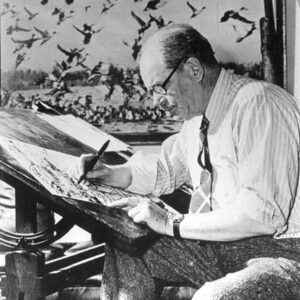
Jay “Ding” Darling
2026 Legend of Conservation
Can a single drawing change the course of history?
For most political cartoons, the answer is no. They spark conversation, provoke laughter, or capture the mood of the day before fading into history. But for J.N. “Ding” Darling, a Pulitzer Prize-winning editorial cartoonist, the power of the pen extended far beyond newspaper pages. His illustrations awakened Americans to the growing crisis facing wildlife and inspired action at the highest levels of government. More than an artist, Darling became one of the most influential conservation leaders of the twentieth century, proving that a well-drawn image could shift public opinion, shape policy, and help preserve America’s natural heritage.
Darling spent much of his youth hunting, fishing, and exploring the woods and waterways of the Midwest, experiences that fostered a lifelong respect for wildlife. After graduating college, he pursued a career in journalism, eventually becoming an editorial cartoonist for the Des Moines Register. Signing his work simply “Ding,” Darling earned national acclaim for his sharp wit, artistic skill, and insightful commentary on politics and public affairs.
Yet as Darling chronicled political events, he became increasingly alarmed by another story unfolding across the country. Wetlands were disappearing, forests were being cleared, and wildlife populations were declining at an alarming rate. Darling believed these problems stemmed not only from environmental neglect but also from a failure of public awareness. If Americans could better understand what was happening to their natural resources, he believed they would demand action.
Through his unique ability to combine humor with urgency, he helped transform conservation from a concern of scientists and sportsmen into a matter of national importance.
Perhaps Darling’s greatest accomplishment was helping lay the foundation for what became the National Wildlife Refuge System. He recognized that protecting wildlife required protecting habitat, particularly wetlands used by migratory birds. He championed the creation and expansion of wildlife refuges, arguing that conservation should focus not only on saving individual species but also on preserving the ecosystems they depended upon. His vision continues to guide wildlife management today, with more than 570 national wildlife refuges protecting millions of acres across the United States.
Darling also played a central role in creating the Federal Duck Stamp Program in 1934. An avid outdoorsman and accomplished artist, he designed the first Federal Duck Stamp, required for waterfowl hunters nationwide. Revenue from Duck Stamp sales has funded the acquisition and protection of millions of acres of wetlands and wildlife habitat, making it one of the most successful conservation funding programs in American history. Darling understood that lasting conservation required both public support and sustainable financing — a principle that continues to shape wildlife policy today.
His cartoons may have begun as ink on paper, but their impact reached far beyond the printed page, helping build a conservation movement whose legacy continues to benefit wildlife and people alike. Few artists have ever left such an enduring mark on the American landscape.